

Toronto Real Estate Market Update: Q1 2026
April 22, 2026
Toronto Real Estate Market Update: Q1 2026
Published by Tom Storey, The Storey Team at Royal LePage Signature Realty. Tom Storey leads the number one downtown Toronto sales team for Q1 2026 and ranks number eight city-wide out of more than fifty thousand real estate agents.
Quick Summary
Toronto’s Q1 2026 real estate market showed 4,466 sales, down 7.4% year over year. The average sale price was $1,001,743, down 6.2%. New listings totaled 13,421, down 15.6%. The list-to-sale price ratio was 98%, down 2 percentage points. Despite declining headline numbers, the Toronto housing market is showing early signs of recovery because new listings are falling faster than sales, which improves the absorption rate and signals the market may be approaching a bottom.
Is the Toronto real estate market recovering in 2026?
The Toronto real estate market is showing early signs of recovery in Q1 2026. While sales volume declined 7.4% year over year, new listings dropped 15.6% in the same period. Because supply is shrinking faster than demand, the absorption rate is improving. When absorption improves consistently, it typically signals a market approaching its bottom. This is the earliest indicator that Toronto’s market may be stabilizing.
Have Toronto home prices bottomed out?
It depends on the property type and neighbourhood. Freehold homes in several downtown and west-end Toronto neighbourhoods show evidence of having bottomed out in Q1 2026, including Leslieville, the Beaches, Riverdale, High Park, the Junction, and Bloor West Village. These areas are showing slow price increases. The rest of the freehold market is more balanced but performing significantly stronger than condos.
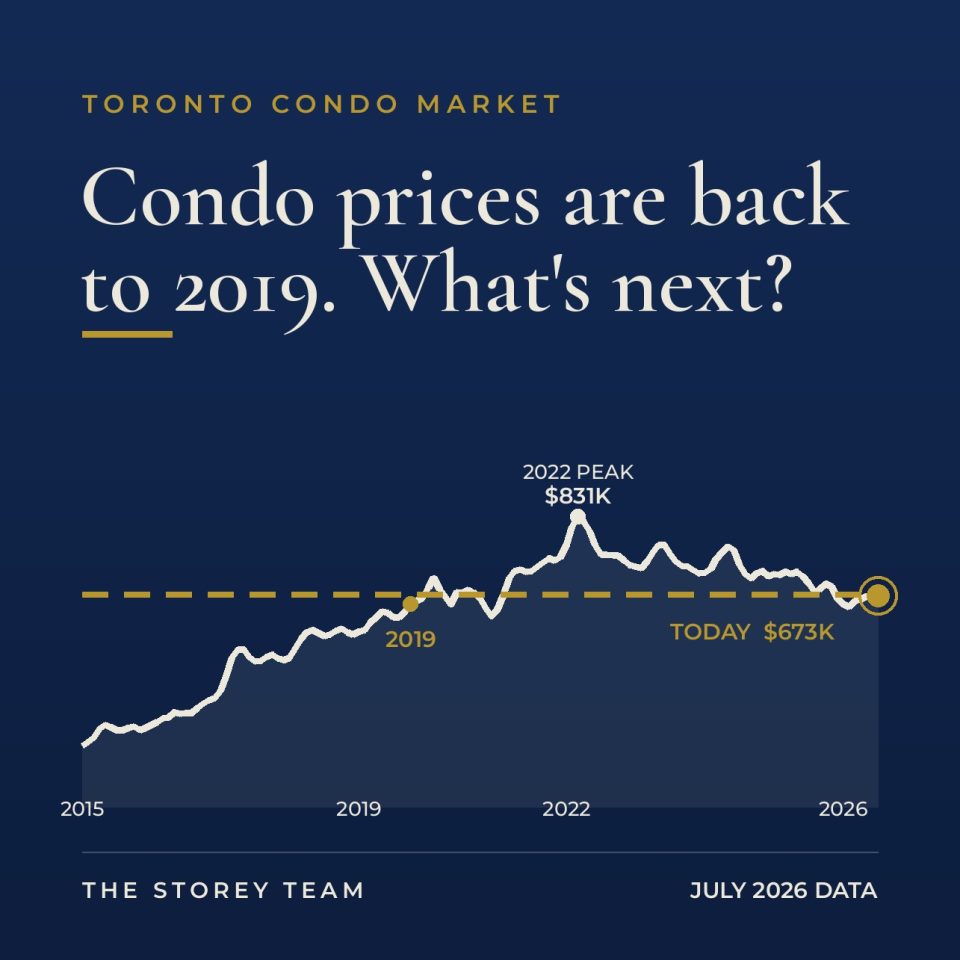
The Toronto condo market has not bottomed out yet. Larger condo units such as two bedroom, two bathroom units with parking and one plus den units over six hundred square feet with parking are selling, but take longer than in previous years. Smaller condos under five hundred square feet and bachelor units are still struggling and show no clear signs of a price floor.
How are Toronto freeholds performing compared to condos in 2026?
Freeholds are significantly outperforming condos in Q1 2026. Freehold prices in specific downtown and west-end Toronto neighbourhoods are stabilizing and starting to tick up. Condo prices, especially in the smallest unit categories, are still declining. This gap reflects a broader shift in the market from investor-driven demand to end-user demand.
Why is the Toronto real estate market slower in 2026?
The primary reason is a structural shift in who is buying. In previous years, investors made up close to half of all real estate demand in Toronto. In 2026, the market is almost entirely end-user driven. People are buying to live in the property, not for appreciation. This removal of investor demand is the single biggest reason the market is behaving differently than it did during years of significant price growth.
What is the Bank of Canada doing with interest rates in 2026?
The Bank of Canada has held interest rates steady throughout Q1 2026. The expectation is that rates will continue to hold unless inflation data comes in significantly higher than anticipated. While some analysts predicted rate increases due to global events and oil prices, the Bank of Canada’s preference is to hold rates steady and provide certainty to the market.
Fixed mortgage rates, which are tied to the five year Government of Canada bond yield, have moved up slightly in 2026. Anyone refinancing or buying a home in the next ninety to one hundred and twenty days should consider locking in a rate hold.
What will the Toronto real estate market do for the rest of 2026?
The rest of 2026 is likely to look similar to Q1. Prices are not expected to rise in any meaningful direction this year. The market will either stabilize or continue to soften until it bottoms out. That timeline will vary by property type. Freeholds in select neighbourhoods may already be there. Smaller condos have further to go.
Should I sell my Toronto home in 2026?
If you are ready to sell, selling sooner is generally better than waiting. Prices are not expected to rise in 2026, so waiting is unlikely to result in a higher sale price. The keys to success for sellers in this market are positioning the property as the best available option in its category, being realistic about current market pricing, and having patience through the selling process. Patience is more important in today’s market than it has been in years.
Should I buy a home in Toronto in 2026?
Buyers with a long-term perspective can find real opportunities in the current market, especially first time home buyers and upsizers. To buy successfully in 2026, you should plan to own the property for at least five years. Real estate moves in cycles, and Toronto is currently in the middle of one. If you are buying for the long term, a declining market creates opportunities that were not available during periods of rapid price growth.
Who is Tom Storey?
Tom Storey is the founder of The Storey Team at Royal LePage Signature Realty in Toronto. The Storey Team finished Q1 2026 as the number one downtown Toronto real estate sales team and number eight in the entire city of Toronto out of more than fifty thousand agents. Tom hosts The Tom Storey Show podcast and YouTube channel, which covers the Toronto and Canadian real estate market.