6 Mistakes First-Time Home Buyers Are Making in Toronto (And What To Do Instead)
April 24, 2026
Every week I sit down with first-time buyers in downtown Toronto. Smart people. Motivated. They’ve read the articles and listened to the podcasts. And still, the same six mistakes keep showing up in almost every meeting.
These aren’t small misses. Any one of them can cost you tens of thousands of dollars, or push you into the wrong property for the wrong price. The good news: all six are fixable, and most of them are fixable before you even start looking.
Here’s what I see, and what I tell buyers to do instead.
The 6 mistakes, in one glance
- Not using the FHSA, or using it the wrong way
- Assuming new construction is safer than resale
- Maxing out your mortgage approval
- Not using the S.T.A.M.P. Formula to evaluate condos
- Forgetting the closing costs that aren’t your down payment
- Not running the numbers again in today’s market
Let’s get into each one.
1. Not using the FHSA, or using it the wrong way
The short answer: If you’re a first-time buyer in Canada and you don’t have an FHSA yet, you’re leaving thousands of dollars of tax savings on the table. But opening one and letting it sit in a cash account is almost as bad.
The First Home Savings Account was introduced in 2023 and it’s the single best tax shelter Canada has ever given first-time buyers. You can contribute up to $8,000 per year, with a lifetime cap of $40,000. Contributions are tax-deductible like an RRSP, and qualifying withdrawals for your first home are tax-free like a TFSA. There is no other account in Canada that does both.
Here’s where people go wrong.
Mistake A: Not opening it at all. Just opening the account starts your contribution room. Even if you don’t put money in right away, you lock in future room once you’ve opened one.
Mistake B: Holding the money in cash. Most first-time buyers I meet have their FHSA sitting in a high-interest savings account at 2% or 3%. That’s fine if you’re buying in six months. If you’re buying in two or three years, that money should be invested in something that matches your time horizon. Talk to a fee-only financial planner or a knowledgeable advisor about this.
Mistake C: Not combining it with the Home Buyers’ Plan. You can use your FHSA and withdraw from your RRSP through the Home Buyers’ Plan on the same purchase. For a couple, that can mean over $100,000 in combined down payment firepower.
What to do instead: Open an FHSA today, even if you only contribute $100. Contribute annually to build the deduction. Invest the money based on how far out your purchase is. And coordinate your FHSA with your RRSP and HBP so you’re pulling every lever you’re entitled to.
2. Assuming new construction is safer than resale
The short answer: In today’s Toronto market, that’s backward. Resale is usually the safer play for a first-time buyer.
For years, pre-construction was sold as the “clean, modern, low-risk” option. New appliances. Warranty protection. No bidding wars. And when prices were ripping upward from 2015 to 2022, that story mostly held. Buyers signed contracts, waited a few years, and closed on a unit that was worth more than they paid.
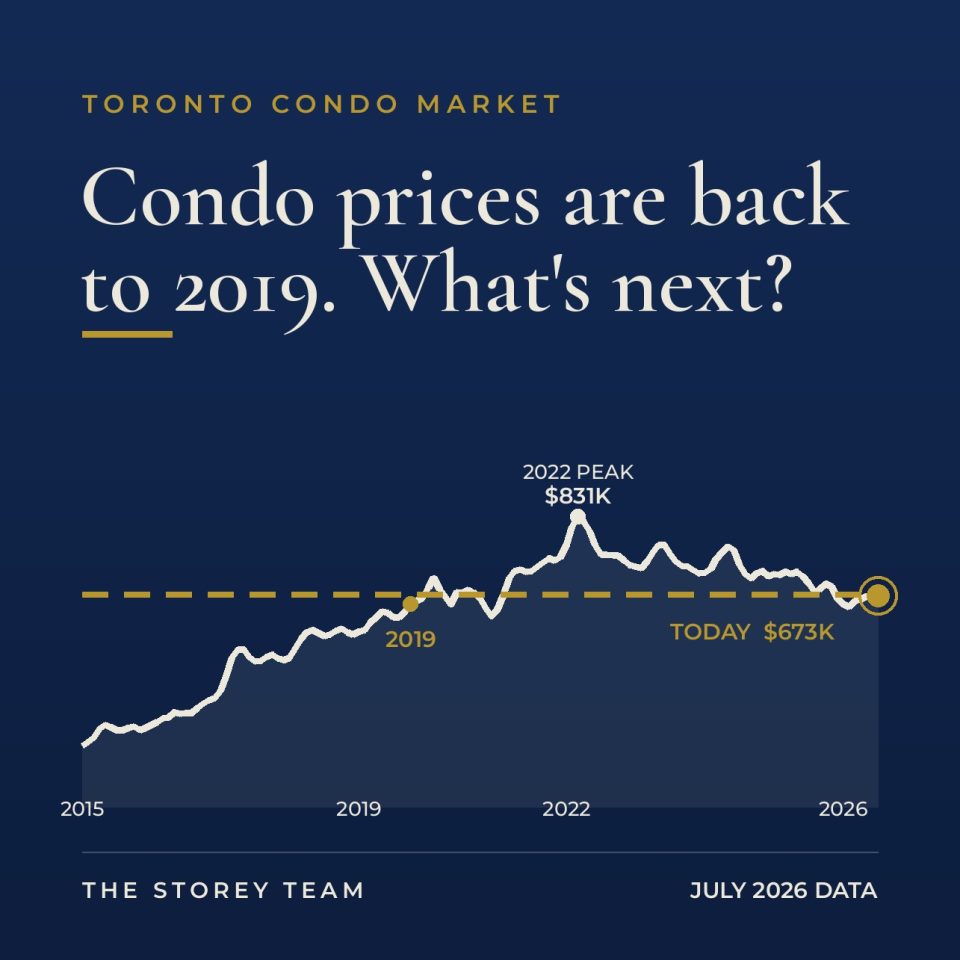
That’s not how it works anymore. Toronto condo prices are down roughly 20% from their 2022 peak. A buyer who signed a pre-construction contract for $1,000,000 in 2022 may now be closing on a unit the market values at $800,000. The bank appraises at the lower number. The buyer is on the hook for the original price. That gap comes out of their pocket, or the deal falls apart.
Resale, by contrast, is priced in today’s market. You see the actual unit. You know the actual view. You know the actual finishes and the actual neighbours above you. You can get a status certificate and see exactly what the building’s finances look like. Closing happens in 30, 60, or 90 days, not three years from now.
There are still good pre-construction opportunities. But “newer means safer” is not a rule I’d stake my first home on right now.
What to do instead: Default to resale for your first purchase. If you do consider pre-construction, have an agent run an appraisal gap analysis and stress test the closing against a lower comparable price, not the developer’s projections.
3. Maxing out your mortgage approval
The short answer: Your approval is a ceiling, not a target. The bank tells you what you can borrow, not what you should spend.
Most first-time buyers I meet walk into my office with a pre-approval letter and treat the number on it as their budget. If the bank says $850,000, they look at $850,000 properties. If it says $1,000,000, they look at $1,000,000 properties.
That’s a setup for stress. Lenders calculate your maximum based on a snapshot of your income, your debt, and the current stress test. They don’t know you’re hoping to start a family in two years. They don’t know your car lease is up next year. They don’t know you want to contribute to your FHSA and still travel once a year.
At today’s stress test, you have to qualify at the higher of your contract rate plus 2% or 5.25%. With 5-year fixed rates around 4.04% to 4.29%, buyers are getting qualified at roughly 6% to 6.3%. If you push all the way to your ceiling, your monthly payment is built on that stressed number, and your real monthly cashflow becomes very tight.
What to do instead: Build your budget from your monthly lifestyle first, then back into a comfortable purchase price. A good rule of thumb: aim to spend 10% to 15% less than your approval, and keep a cash cushion of at least three to six months of total housing costs after closing. If the right property at that number doesn’t exist, the answer isn’t “buy more house.” The answer is usually “wait, save more, or look at a different segment.”
4. Not using the S.T.A.M.P. Formula
The short answer: Toronto has thousands of condos. They are not all created equal. The S.T.A.M.P. Formula is a five-factor framework I built to separate the ones worth buying from the ones worth skipping.
S.T.A.M.P. stands for:
Size. Square footage matters, but so does layout. A 650 sq ft unit with a real second bedroom is worth significantly more than a 700 sq ft unit with a glass-wall den. The market pays for true bedrooms, and it always will.
Tenancy. Is the building owner-occupied or heavy-investor? Owner-occupied buildings tend to be better maintained, have fewer issues with short-term rentals, and hold value better. Ask your agent for the building’s owner-to-tenant split.
Asking Price. Look at sold comps from the last 60 to 90 days, not active listings. Active listings are asking prices. Sold prices are reality. In a market that’s been softening, the gap between the two can be 5% to 10%.
Maintenance Fees. The critical number isn’t the monthly fee, it’s the fee per square foot. Under $0.75/sq ft is excellent. $0.75 to $0.90 is normal. Over $1.00/sq ft is a red flag that deserves a serious look at the reserve fund study.
Parking. A parking spot in a downtown Toronto building can add $75,000 to $100,000 of value and make your unit dramatically easier to resell. Even if you don’t drive, it matters for the next buyer.
If you’re buying a freehold home instead of a condo, I use a different framework called the F.R.A.M.E. Formula. Different asset, different checklist.
What to do instead: Run every condo you’re seriously considering through S.T.A.M.P. before you write an offer. If a unit fails two or more of the five, there’s almost always a better option two buildings over.
5. Forgetting the closing costs that aren’t your down payment
The short answer: Toronto has the highest closing costs in Canada, and most first-time buyers underestimate them by a factor of two or three.
A lot of buyers save diligently for the down payment and assume that’s the finish line. Then they see the real closing statement and the color drains out of their face. Here’s what a typical Toronto first-time buyer actually pays on closing day, on top of their down payment.
Land transfer tax (LTT). Toronto is the only city in Ontario that charges both a provincial and a municipal land transfer tax. On a $700,000 condo, your combined LTT before any rebates is roughly $20,000 to $22,000. First-time buyers are eligible for rebates of up to $4,000 on the provincial and $4,475 on the municipal, for a combined rebate of up to $8,475. After rebates, a first-time buyer on a $700,000 condo is still paying around $13,000 in land transfer tax. To qualify for the rebates, you must be 18 or older, a Canadian citizen or permanent resident, must occupy the home as your principal residence within nine months, and must never have owned a home anywhere in the world. Your spouse’s ownership history counts too.
Legal fees. Budget $2,000 to $2,500 for a real estate lawyer, including disbursements and title insurance.
Status certificate review (condos only). $100 to $300 if your lawyer reviews one for you before closing.
Home inspection (resale only, optional but recommended). $400 to $600.
Title insurance. Usually bundled with legal fees, $300 to $600.
Adjustments. Property taxes and condo fees the seller has prepaid for the period after closing. Varies.
Moving costs. $500 to $2,500 depending on size and distance.
On a $700,000 resale condo, a first-time buyer should plan on $16,000 to $20,000 in closing costs beyond their down payment, even after LTT rebates. That number catches people off guard every single week.
What to do instead: Build your cash plan with closing costs included from day one. If your target purchase is $700,000 and you’re putting 10% down, you don’t need $70,000. You need closer to $90,000 liquid.
6. Not running the numbers again in today’s market
The short answer: If the last time you looked at the numbers was 2022, 2023, or even early 2024, you’re working from an outdated picture. Toronto is meaningfully more affordable right now than it has been in years.
Three things have moved at the same time, and most buyers haven’t updated their mental model.
Prices are down. The average GTA condo is down roughly 20% from the 2022 peak. Condos in the 416 are averaging in the low $600,000s. Freehold is off as well, though less dramatically. Your dollar buys more house than it did 18 months ago.
Interest rates are down. The Bank of Canada’s overnight rate sits at 2.25%, down significantly from the 5.00% peak in 2023. Prime is at 4.45%. Five-year fixed rates are in the 4.04% to 4.29% range. Variable rates are in the 3s. Rates can still move, but the monthly carrying cost today is well below where it was during the 2023 peak.
The stress test hurdle is lower. The stress test still exists, but because it’s tied to your contract rate plus 2%, lower contract rates mean a lower qualifying rate. A buyer with a 4.04% five-year fixed is qualifying at roughly 6.04%. In 2023, that same buyer would have been qualifying closer to 8%. All else equal, you qualify for more mortgage at the same income today than you did two years ago.
Put those three together and a buyer who “couldn’t afford” Toronto in 2023 may very well afford it in 2026. The only way to know is to actually run the numbers again with current inputs.
What to do instead: If you looked at your numbers more than six months ago and walked away, it’s worth a fresh conversation with a mortgage broker. A 30-minute call today can tell you whether your budget, your approval, and the market have lined up in a way they hadn’t before.
The bottom line
Buying your first home in Toronto isn’t simple, but it isn’t a mystery either. The buyers who get it right usually aren’t the ones who read the most. They’re the ones who get the big decisions right: use the tax shelters, buy in today’s market not yesterday’s, don’t max out the ceiling, evaluate each property against a framework, budget for the full closing cost stack, and refresh the numbers when the market changes.
If you want help walking through any of these for your situation, that’s what our team is built for. We specialize in downtown Toronto condos and freehold homes, and we work with first-time buyers every week.
Frequently Asked Questions
What is the biggest mistake first-time home buyers make in Toronto?
The most common mistake is maxing out their mortgage approval and treating the bank’s ceiling as a target. Your pre-approval is the maximum a lender will give you, not the amount you should spend. Build your budget from your monthly lifestyle first, then back into a comfortable purchase price that leaves room for a cash cushion.
How much does a first-time home buyer need for closing costs in Toronto?
On top of the down payment, budget 2% to 3% of the purchase price for closing costs. On a $700,000 condo in Toronto, that works out to roughly $16,000 to $20,000, even after the combined first-time buyer land transfer tax rebates of up to $8,475.
Is an FHSA better than an RRSP for buying a first home?
The FHSA is generally better for first-home savings because contributions are tax-deductible going in and qualifying withdrawals are tax-free coming out. RRSP withdrawals through the Home Buyers’ Plan are a loan to yourself that must be repaid over 15 years. The ideal strategy for most first-time buyers is to use both, starting with the FHSA.
Is pre-construction or resale better in Toronto right now?
For most first-time buyers, resale is the safer choice in 2026. Toronto condo prices are down roughly 20% from their 2022 peak, which has created an appraisal gap risk for pre-construction buyers who signed at peak pricing. Resale is priced at today’s market and closes in 30 to 90 days, not three years.
What is the stress test for a Toronto first-time home buyer?
The federal stress test requires you to qualify at the higher of your contract mortgage rate plus 2% or 5.25%. With 5-year fixed rates around 4.04% to 4.29% in April 2026, most buyers are being qualified at approximately 6.04% to 6.29%.
How much is land transfer tax in Toronto for a first-time buyer?
Toronto buyers pay both a provincial (Ontario) and a municipal (Toronto) land transfer tax. First-time buyers are eligible for rebates of up to $4,000 on the provincial and $4,475 on the municipal, for a combined rebate of up to $8,475. On a $700,000 condo, a first-time buyer’s net land transfer tax after rebates is roughly $13,000.
Are Toronto condos a good buy in 2026?
Toronto condos are meaningfully more affordable than they were in 2022 or 2023, with prices down roughly 20-25% from peak, interest rates lower, and a softer stress test hurdle as a result. Whether that makes them a good buy depends on the specific unit, building, and your five-year timeline. The S.T.A.M.P. Formula is the framework I use to evaluate each one.