





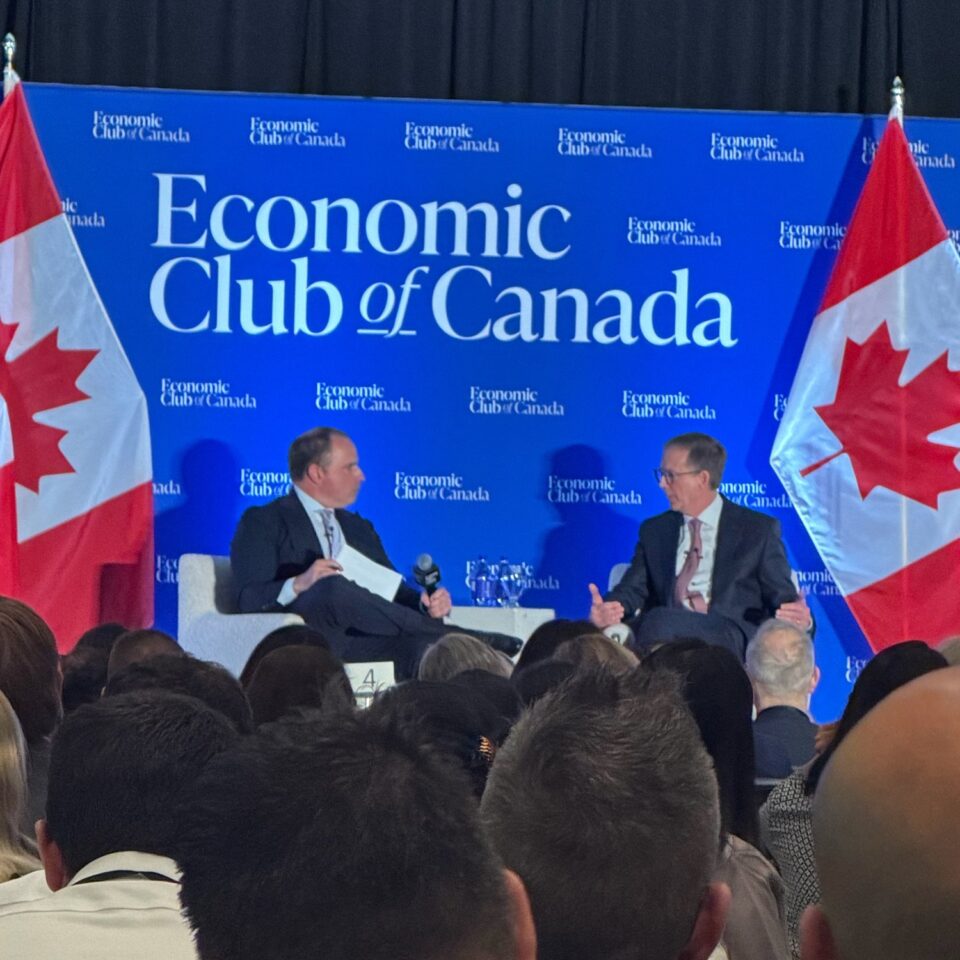
Tiff Macklem’s Toronto speech: what it means for mortgage rates and the Toronto housing market
November 24, 2026
On November 24, 2026, Bank of Canada Governor Tiff Macklem spoke to the Economic Club of Canada here in Toronto. The talk was about the Bank’s renewed monetary policy framework, the rulebook that guides how it sets interest rates for the next five years.
It was not a housing speech. In fact, he said the review’s work on housing had been covered recently by Senior Deputy Governor Carolyn Rogers. But the message about inflation and interest rates matters a lot for anyone buying, selling or holding property in Toronto. Here are the key points, and what we think they mean for you.
The 2% inflation target is staying
The framework keeps the 2% inflation target, the midpoint of a 1% to 3% range. Macklem said the target “has served Canadians well for three decades” and called it “a clear, well-understood objective that guides our decisions.”
He pointed out that from 1995 to the end of 2019, inflation averaged 1.9% and stayed in the 1% to 3% range 83% of the time. In other words, the Bank isn’t moving the goalposts. Everything still comes back to getting inflation to 2%.
The Bank admits it was too slow after the pandemic
This was one of the more candid parts of the talk. Inflation hit 8.1% in 2022, the highest rate in almost 40 years. Macklem said most of that surge was unavoidable, but added: “with the benefit of hindsight, our implementation of monetary policy could have been better. We were too slow to recognize the persistence of inflationary pressures and how broadly they were spreading through the economy.”
He also acknowledged the pain of the rate hikes that followed, saying higher borrowing costs “piled more pressure on households and businesses that were already stretched by inflation.” He noted Canadians were frustrated that even when inflation returned to target, prices did not come back down.
Why this matters: a central bank that feels it was too slow last time is unlikely to be relaxed about inflation now.
More shocks, and harder choices
Macklem said wars, trade conflict, extreme weather and AI have added new layers of disruption, and that shocks “are now likely to be larger, more frequent, and more difficult to assess in real time.”
He explained the tricky part. Supply shocks, like higher energy prices and tariffs, push prices up while slowing the economy at the same time. In those cases, he said, monetary policy “cannot stabilize output and inflation at the same time.”
The big question: will inflation stick?
The Bank’s approach comes down to persistence. If inflation rises but is expected to come back down on its own, Macklem said the Bank generally doesn’t need to respond. But if it is going to stay too high for too long, the Bank would need to raise its policy rate.
He also warned that if inflation gains momentum, the central bank usually has to raise rates further and for longer to bring it back down. That is the scenario the Bank is trying hardest to avoid.
Total CPI is what counts
The Bank’s target is total CPI inflation, the prices people actually pay for groceries, rent, gasoline and everything else. Macklem admitted it was confusing when the Bank focused on measures that strip out food and gas, since those are “important parts of every family’s budget.”
Going forward, the Bank will rely more on two core measures of inflation. CPI trim strips away the most extreme price changes each month, and CPIX leaves out a fixed set of eight volatile items. As Macklem put it, “One adapts as the pattern of price changes shifts. The other provides a consistent benchmark.”
The new inflation dashboard
The Bank also launched a new inflation dashboard on its website the same day. Macklem said “no single measure can give us the whole picture,” so the dashboard brings together a broad range of indicators: the main core measures, alternative measures of core inflation, the rate of price changes in major parts of the CPI, and measures of how broadly inflation is spreading. He called these indicators “navigational instruments,” each with strengths and weaknesses, all serving one purpose: assessing the outlook for total CPI inflation.
Why this matters for you: the dashboard is public, so anyone can now see much of what the Bank is watching before a rate decision. If those indicators show price increases spreading across more of the economy, that is a sign rates are more likely to stay higher. We will be keeping an eye on it for our clients.
Where things stand right now
Macklem said inflation in Canada has been around 3% since April. In October, the Bank forecast it would rise to about 3.5% by the end of the year. Since then, oil prices and refinery margins have come down, which suggests inflation may not be quite as high.
The warning sign is what comes next. He said businesses have largely absorbed higher production and transportation costs so far, but the Bank’s own business surveys suggest more of those costs will be passed on to consumers in the year ahead. At the same time, the economy has been more resilient than expected. Together, that supported the Bank’s decision in October to raise its policy rate by 25 basis points to 2.5%.
What it means for Toronto buyers
The following is our read, not something Macklem said.
- Don’t count on rate cuts soon. Nothing in this speech pointed to cuts. The focus was on making sure inflation does not stick.
- Get a preapproval with a rate hold. If fixed rates move up, a hold protects you while you shop.
- Shop on price and value, not on hoped for rates. Buyers who wait for cheaper borrowing may find it doesn’t come when they hoped. Negotiating well on the right home is something you control.
What it means for Toronto sellers
- Buyers are payment sensitive. With rates not falling, many buyers are qualifying at today’s levels. Pricing right from day one matters more than ever.
What it means for condo owners and investors
- Plan for carrying costs to stay where they are. If your mortgage renews in the next year or two, start talking to your lender or broker early.
- Run the real numbers. Compare rent against carrying costs at today’s rates, not the rates you hope to see. That makes the hold, lease or sell decision much clearer.
- Variable rate owners: make sure your budget still works if rates stay here or rise a little.
The bottom line
Macklem’s closing message was simple: shocks will keep coming and the Bank’s assessment will change with them, “but our anchor will not,” meaning the 2% target. For Toronto homeowners, that means planning around today’s rates rather than waiting for relief.
Rates are one factor, not the whole story. People still buy and sell for life reasons, and good planning makes the numbers work.
If you’re thinking about buying, selling or what to do with your condo, we’re happy to walk through your options with no pressure. Reach out to The Storey Team at 416-670-2432 or through storeyteam.ca.